Sunday, October 28, 2007

day 2 - The Great Wall - 6 Nov 2006

I have no idea what we did in the morning. I certainly do not appear to have taken any photos. In the afternoon we headed out to SiMaTai. It seems that this place has caused much confusion to cause people to think that I went to SiMaSai in Thailand. But that is another story.

This was my second visit to this location. I went there in 1999 and climed up to the right. It is when my vertigo struck back with a savage vengeance. In the image below it is the part of the wall in the distance. I was walking up the wall with no problems. Then we hit a part with no sides and with just a mound of rock. I turned around and saw the thousand foot drop and went week in the knees. I had to let the others continue. I could not go on. Two American men, coming back down the wall talked me down to a flat part. I thanked them and was very grateful.

"great wall" by yewenyi [?]
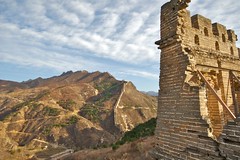
great wall

This time we headed up to the left. It was not without issues as a suspension footbridge had to be crossed and when I got further up I could not continue on the sections with no sides and had to wait for the others to return. Because it was a photography trip, Ewen arranged for us to be there at the best time of day to get the best light. Hence I have a nice set of images with great light.

"suspension bridge" by yewenyi [?]
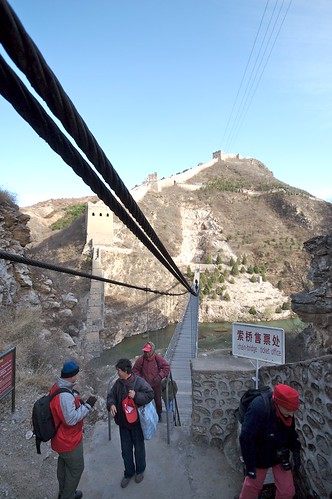
suspension bridge

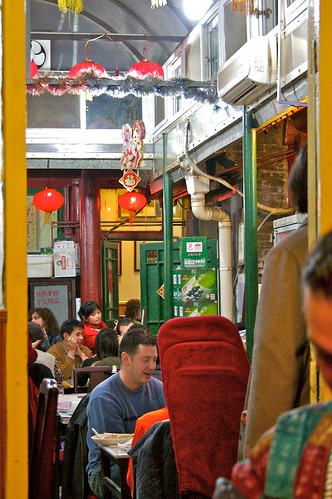
In the evening we stopped off at a restaurant en-route to Beijing and had a nice meal in a very steamy restaurant.

"Ordering Dinner" by yewenyi [?]
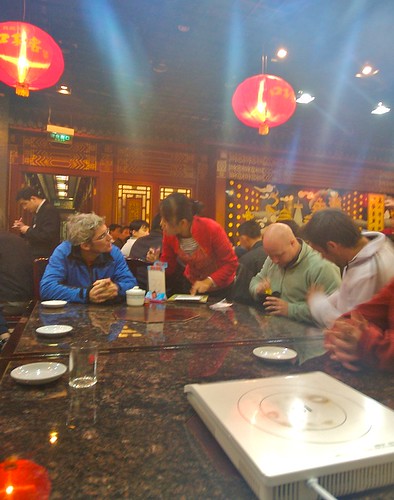
Ordering Dinner

Saturday, October 20, 2007

want or need?

When in BeiJing in 1999, I was wandering back from the CBD to my accommodation at BeiJing University. Rather than go the direct route, I headed off to one side to see what was there. I did not know it at the time, but this was supposedly a more disreputable part of town.

I came to an intersection. There was a group of 5 people, 4 men and one woman. They were standing in the center of the road at a trolley bus stop. They saw me coming and there was some odd body language in their reaction. Perhaps they were surprised. As I approached the woman cupped her hands, like she was holding some testicles and said what I thought was you ma? This confused me greatly and the quickly scattered.

With reflection I think she probably said yao ma? That is need? rather than have? In characters the difference is much clearer.
  • 要嗎 need/want?
  • 有嗎 have?

Friday, October 05, 2007

A first day for Photography - 5 November 2006

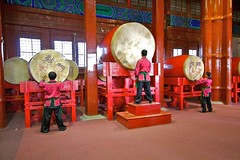
The next day was officially the first day of the tour. In the morning we headed off to the Drum tower and spent the morning wandering the Hutongs. The tower was quite impressive and we were there for a session on the drums. It also has good views of the city. From here it is clear that BeiJing is donut shaped. There is the old city, surrounded by the old suburbs and then by ring of modern high rises. I was quite impressed from up here about how the development had been handled on the macro scale.

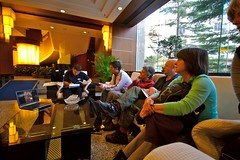
"group meeting" by yewenyi [?]
group meeting

"bang the drum" by yewenyi [?]
bang the drum

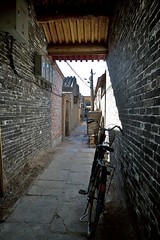
We wandered through the hutongs. I do not remember which bit I visited in 1999, but the 1999 version was alive and vibrant. Markets and people everywhere. Maybe different parts are different. Maybe the decline of these places as people move out is the cause. Now the place was a bit deserted and the famous wind and dust of BeiJing were in full force. There were lines of rickshaws for the tourist trade and people selling food. Before I left many people here in Australia commented on how it was a tragedy that the government was pulling down the hutongs. But I do not feel this way. I certainly feel that some should be kept as a historical zone. But life in the hutongs is not pleasant. Mostly families live in one or two room houses around a courtyard. There is a communal toilet for the courtyard. There is no running water and the houses have no kitchens. So they eat out all the time, which is the source of china's well know and excellent cuisine. Also the lack of fridges means that it is a more effective method of suppling food to have a central restaurant using freshly made produce in significant quantity. It minimizes the need for storage.

"down into the depths" by yewenyi [?]
down into the depths

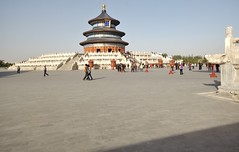
In the afternoon Ewen and I went to the Temple of Heaven to have a private photography lesson. I had visited the temple in 1999 and remember being generally unimpressed. But this time it was much more interesting. They have spent a lot of money on repainting it and doing other restorations. So it was the opposite of the hutong experience. The glory of Imperial China had been restored.

"Hall for prayer for good harvests" by yewenyi [?]
Hall for prayer for good harvests

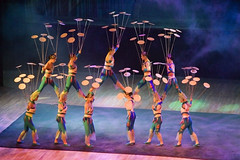
In the eventing we went to see the acrobatics. I was not really interested in going as I was expecting a dull tourist driven experience. But I was pleasantly surprised. While it is clearly set up for the tourists, it was a good sampler of the different dance styles. Kind of like a compilation CD is for music of an era.

"Acrobatic plate twirling" by yewenyi [?]
Acrobatic plate twirling

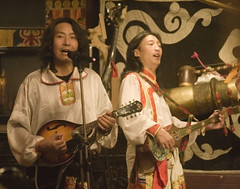
Afterwards we retired to a Tibetan restaurant in the diplomatic district. It was a bit americanized, but we had Yak. Hm, I do not think Yak is one of my favorite meats. But maybe it was the preparation. Unlike the others I really enjoyed the music.

"Tibetans" by yewenyi [?]
Tibetans

Saturday, September 29, 2007

Police and Courts

When I was in China in 1992, there was quite a lot of discussion in the English Language press about the lack of a judiciary. In China the police were responsible for arresting you and then prosecuting you and sentencing you. As you can imagine it is a quite unsatisfactory state of affairs that will not only lessen the rule of law, it is subject to endless corruption and abuse of power worries. I suppose for a one party state, abusing power is part and parcel of the ruling system so it suits them to be this way. However, China at the time was looking at a way out. In my subsequent travels I did not come across any information as to what changes had been made, if any in this system.

It is with dismay that I note that there is great disdain in the police force, media and some major political elements here in Australia for the Judiciary and rule of law. These people are leading us down a path that will allow one party rule as exists in China.

Friday, September 14, 2007

living in a land with no fridges

For a while now, I have been providing flashbacks to my visit to China in 1999, but I also visited in 1992. Back then China was just emerging from the years of communist rule and the economy was starting to develop into a market economy. But it still had a long way to go.

In Australia we always take note of the live fish in the windows of Chinese restaurants, and some snobby Australians turn their noses up at this tradition. They think it is distasteful. But I found in China very quickly that in fact it is a good sensible way of knowing that you are not going to die of food poisoning. In a country where there is no refrigeration and food is food fresh, rather than pickled or salted, it is vital to know that your food is fresh. There can be no fresher food than that has been recently slaughtered. So any enterprising restaurant owner will go a long way to prove that their food is fresh.

For seafood proving that the food is fresh means showing that it is still alive and looking healthy. For meat, it meant having the meat proudly on display on a counter and letting the patron see the food taken away to be cooked.

Now that there are fridges and more importantly the electricity to run them, this presentation method is much less common.

Tuesday, September 11, 2007

北京

I speak occasionally with Australians who think that the Communist government changed the name from Pei King to Bei Jing when these are both different romanization of the same name. They think that the Communist Chinese government changed the name for the same propaganda reasons as the Vietnamese changing the name of Saigon to Ho Chi Minh city or The Soviets the name St Petersburg to Stalingrad. This shows little understanding for Chinese History. Here is a little excerpt from Wikipedia:
Peking is the name of the city according to Chinese Postal Map Romanization, and the traditional customary name for Beijing in English. The term originated with French missionaries four hundred years ago and corresponds to an older pronunciation predating a subsequent sound change in Mandarin from [kʲ] to [tɕ][citation needed]. ([tɕ] is represented in pinyin as j, as in Beijing), and is still used in some languages (as in Dutch, German, Hungarian, Polish and Spanish).

In China, the city has had many names. Between 1368 and 1405, and again from 1928 [1] and 1949, it was known as Beiping (; Pinyin: Beiping; Wade-Giles: Pei-p'ing), literally "Northern Peace". On both occasions, the name changed — with the removal of the element meaning "capital" (jing or king, 京) — to reflect the fact the national capital had changed to Nanjing, the first time under the Hongwu Emperor of the Ming Dynasty, and the second time with the Kuomintang (KMT) government of the Republic of China, so that Peking was no longer the capital of China.

The Communist Party of China reverted the name to Beijing (Peking) in 1949 again in part to emphasize that Beijing had returned to its role as China's capital. The government of the Republic of China on Taiwan has never formally recognized the name change, and during the 1950s and 1960s it was common in Taiwan for Beijing to be called Beiping to imply the illegitimacy of the PRC. Today, almost all of Taiwan, including the ROC government, uses Beijing, although some maps of China from Taiwan still use the old name along with pre-1949 political boundaries.


Sunday, September 02, 2007

Back to BeiJing

Back in Bei Jing, I met up with the tour group the first evening in the city. It was our first day together as a tour group. Several people had been in BeiJing for a few days. I will introduce the people over the next few posts. The tour I was on was organized by my friend from Melbourne, Ewen Bell and run by Grasshopper Tours. The tour nominally includes 8 people, Ewen and out guide.

I had spent the day wandering south through the city with Elliot, one of my co-travelers and room mate for the first few days. We had lunch south of the BeiJing railway station. I ordered hot and sour soup, but while good, it was not the real thing. Instead is was egg flower soup, with chicken and pepper. I also had a bit of difficulty with the difference when ordering between two bowls of soup and one bowl of soup with two bowls. Ah well, that's what happens when your Chinese is not so good.

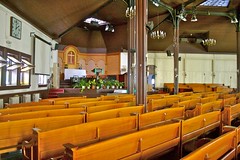
In the hutongs south of the station we came across a octagonal church. The man there could not explain in English what type of church it was. He wanted 100 元, but at first I did not understand what he wanted 100 of and then decided that was a bit ridiculous. We moved on.

"church" by yewenyi [?]
church

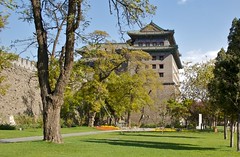
Next we came to the southern wall. The tower here was the one attacked in the Allied invasion during the boxer revolt. The Chinese are still furious with the amount of damage caused to national artifacts at this time by the invading British. Anyway I am guessing that the tower was rebuilt after the war. Further along the wall is the hole in the city wall made to let the railway line through when the British built a railway line from here to the north.

"tower" by yewenyi [?]
tower

We wandered back to the city and met up with the others. We met in the foyer. Everyone was relaxed and it was a nice group of people. First things were about getting to know each other and to understand the organization. We went out for our first dinner, PeiKing duck in a hutong restaurant.

"restaurant" by yewenyi [?]
restaurant